Hi, I’m
I don’t do sales calls. I stopped chasing the algorithm. Most of my clients have already decided by the time we talk.
I help you build your own version of that, around how you like to sell. For experienced experts who are good at selling and tired of being the only thing that makes it happen.
If every sale needs you, it’s a performance. Not a system.
You don’t have a sales problem. You have someone else’s sales system.
You can sell. You’ve been doing it for years. You know what to say when someone hesitates about the price, you follow up when they go quiet, and you post because everyone tells you to stay visible.
It works. And every year it takes a little more out of you.
That’s what happens when you sell with a method built for somebody else. The script written for the guy who enjoys the chase. The posting schedule made for the woman who loves a camera. You can learn all of it, and you can get good at it. I did. Then I realised I didn’t like who I’d become.
I believe your sales system should be built on what you’re already good at. And it shouldn’t need you every day.
If you’re at your best in a conversation, use the conversation. If you write better than you talk, let your emails do the selling.
Most of what you were taught about selling, I don’t believe.
Objections are information.
“I need to think about it” usually means exactly that. The moment you start working on someone’s hesitation, you’ve stopped helping them decide and started trying to change their mind.
A no is allowed to be a no.
I’d rather have a clear no in week one than a reluctant yes we both regret in month three.
The sale happens before the call.
If you need an hour to convince someone, something was missed long before they booked. And if they’d already decided, your mum could have closed that call.
Your next client is already in your phone.
You just haven’t asked them yet. Most experts go hunting for strangers while the people who already trust them haven’t heard from them in a year.
You don’t need to post every day to get clients.
I stopped. Have a look at my Instagram.
A client you talked into it is a client you’ll keep convincing.
They question the invoice, push back on the work and need reassurance every other week.
Your business should give you choices.
A week off without your income dropping. A phone on silent. A no to the client you don’t want.
I refuse to use a sales system that needs me every day. I don’t think you should either.
Find out how you sell. Free Sales Behaviour Profile→I hated selling. Then I got very good at it.
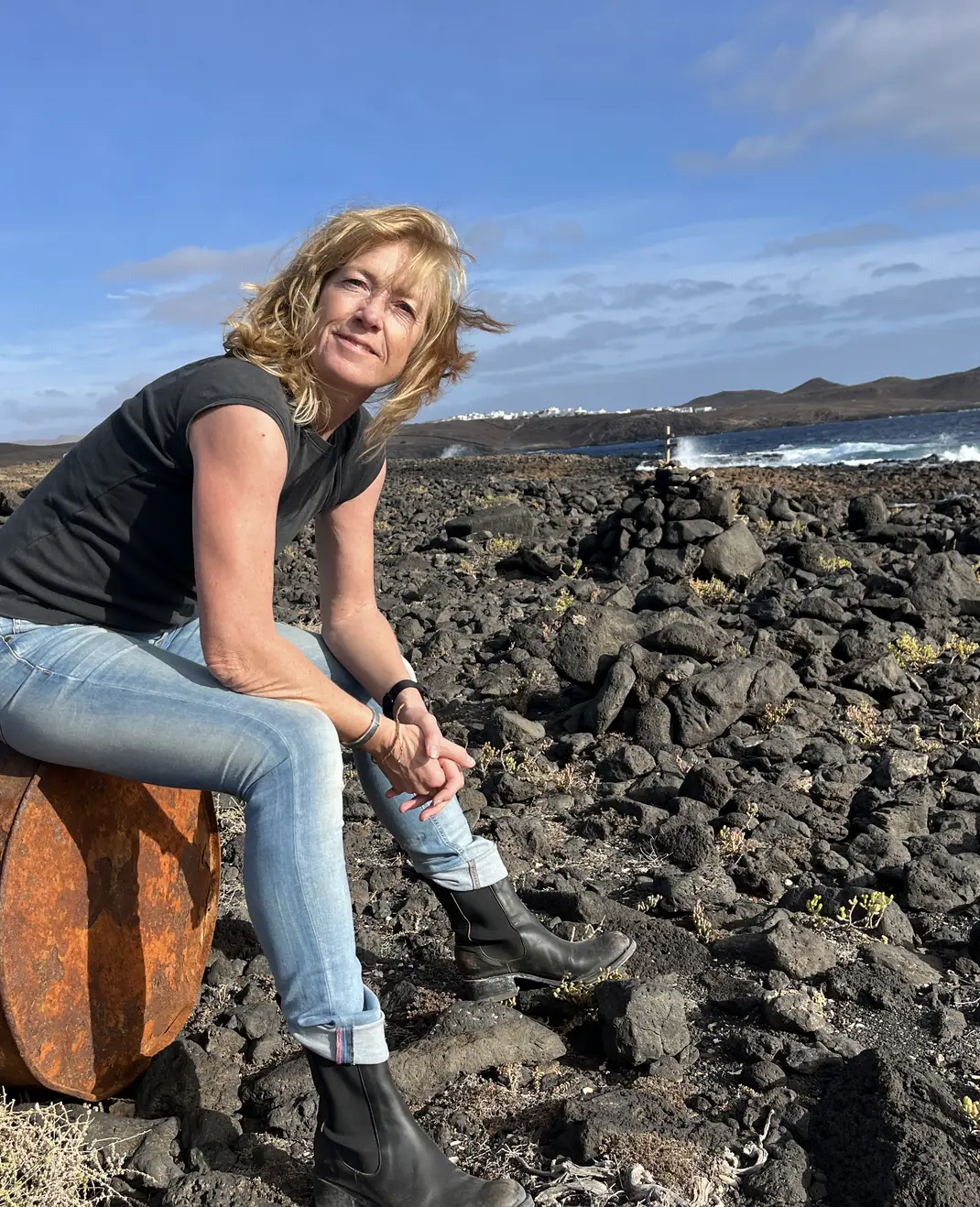
In 2004 I stood at a conveyor belt in a spice factory at five in the morning, packing soup mix into boxes so I’d have the afternoon free for my first business. Clients weren’t coming, and everyone told me to be more visible.
What I was really avoiding was selling. The version I’d been shown was all chase, and it made my skin crawl.
So I learned it anyway. Scripts, follow-ups, objection handling, the lot. Good enough to build six businesses, work with more than 1,000 entrepreneurs and write a book that became the #2 marketing bestseller in the Netherlands.
But I didn’t always feel good about the yeses. For half an hour on a call I’d turn into a slightly different version of myself, just to get someone to buy.
So I started looking at the people who said yes and stayed. They’d almost always decided before they ever spoke to me. I rebuilt my business around that.
I sell the way I like to: by writing. I post an article on Substack every Friday, which I also share on LinkedIn, and I write to my email list three times a week. What’s yours is what you should build on.
I went from around twenty sales calls a month to none. Most of my clients decide after reading my emails. My calendar is mostly empty, my phone is on silent, and my day in Lanzarote starts with the dogs, not the laptop.
Twenty years of selling taught me one thing worth putting on a homepage. The right people don’t need to be pushed. They need to be led.
Sales Without ForceFrom Willpower to Influence
First we find out how you sell best. Then we build your system around it, once. After that it keeps bringing clients in without you carrying every sale.
Know how you sell
15 minutes- Find out how you sell when nobody hands you a script
- See which parts of selling drain you, and why
- Spot where the way you were taught works against you
Build it around you
30 to 90 days- Turn the people who already know you into clients
- Let people know what you do and what it costs before they book
- Have conversations that end in a clear yes or a clear no
Grow without pushing
from then on- Stop chasing people who went quiet
- Get clients who come back and send people your way
- Take a week off and still get a yes
The problem was never where they thought it was.
Real clients. Real conversations.
What changed when selling became a conversation, not a performance.
More revenue. More calm.
Your own way.
Not more hustle, but a way of selling that feels good, creates stability and actually fits who they are.
€60,000 from a group programme she didn’t have before.
She thought she had a visibility problem. She posted every day and said yes to every discount and payment plan a client asked for. Now one paid diagnosis leads into her group programme, and people sign up without a sales call. That programme alone brought in €60,000 this year. The diagnosis, also new, brought in another €6,000, and the price of her 1:1 work went from €5,000 to €15,000.
Sold out for four years. Four times as many programmes.
She was running her own ads with help from someone at Facebook, and every platform change sent her back to the start. I’ve handled her marketing for more than four years: the ads, the emails, the open days, her website. She now works with seven teachers across the Netherlands, and she spends her time teaching.
Revenue doubled in a year
No one-size-fits-all. He got to stay himself.
Earning more, and calmer with it
Six times more programmes sold, after one conversation
Half a year’s revenue matched a full year. On two blog posts.
Real conversations.
New clients.
In one week: From personal messages and warmer conversations to signed assignments. These entrepreneurs didn’t chase harder. They had better conversations.
20 personal messages. 2 new assignments.
7 messages, 7 replies, 2 bookings
Two clients from people she already knew
She took the lead in the conversation. The client said yes.
Clearer insight.
Better decisions.
Their diagnosis showed exactly where clients dropped off, what was missing in their system, and where they had been guessing. That clarity led to real change.
Two busy seasons a year. Now something sells in between.
He’d been guessing what his clients wanted
A marketing professional who still needed a second pair of eyes
More stories. In their own words.
No more marketing tricks she never liked doing
Everyone has a blind spot. Anneloes finds it straight away.
He was working hard on the wrong things
Her business coach couldn’t help her with this
Marketing that fits her and her mission
Razor-sharp, again
No more posting five times a week
Less social media, a list 50% bigger
She was only busy being visible
She doesn’t have to be like everyone else
No success formula pushed on her
Step by step, her way
Allowed to be more outspoken
She thought her ads weren’t working. It was her page.
After all those courses, the first thing that landed
Practical, where others stayed high-level
Concrete answers, for once
No bullshit
Three ways in.
Know how you sell
Sales Behaviour Profile
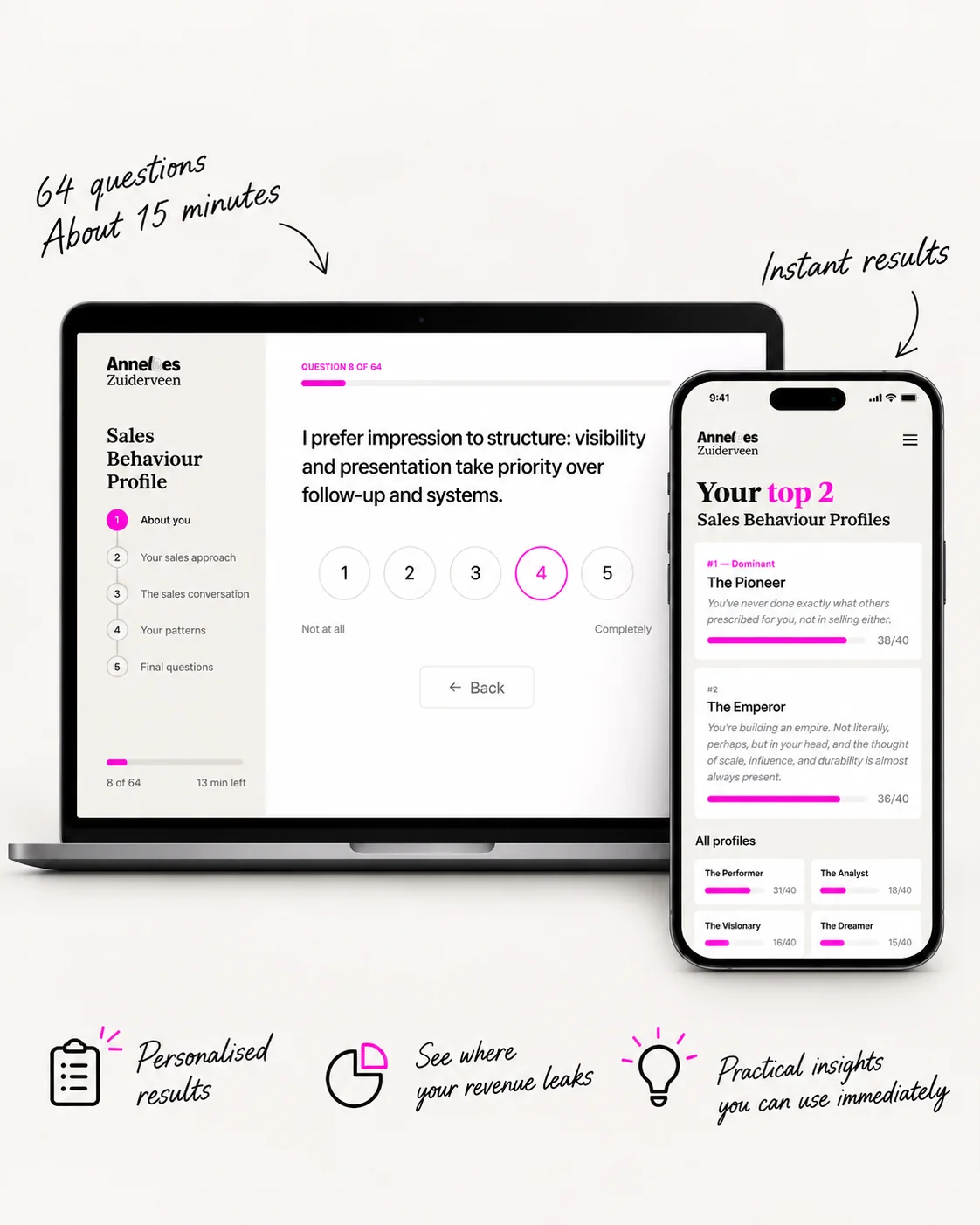
Find out how you sell when nobody hands you a script. 64 questions, about 15 minutes, and you get a personal report: which of the eight sales profiles is yours, where your way of selling is strongest, and which parts of selling cost you the most energy. Free.
Start with the people who know you
The Permission Method
A way to turn the people who already know you, past clients, your network, people who’ve read you for years, into clients without chasing, pushing or closing techniques. For 90 days you have Smith at your side, my AI assistant trained on the method, to help you apply it to your own contacts. €144.
Build it with me
Work with me
Everyone who works with me starts with The Reveal. I go through your business the way a potential client does and show you exactly where they stop. You get a written plan and a follow-up call four weeks later. If you want to build your system together after that, we take it from there.
Before you build anything, find out how you sell.
Every system I build starts with the same question. How do you sell when nobody hands you a script?
Some people warm up a room and get a yes before they’ve mentioned a price. Others only take on clients they’ve checked three times, and would rather write an email than pick up the phone. Both can sell perfectly well. They just shouldn’t be using the same system.
The Sales Behaviour Profile shows you how you sell, and where the way you were taught is working against it. 64 questions, about 15 minutes.
Free. And nothing to buy if you don’t want to.
P.S. When you finish the profile, you’ll also get my emails. Three a week, with the things I don’t say in public. Read the ones you want and skip the rest.
Questions about selling expertise.
The ones that come up most, answered straight.
They didn’t lose interest. Most of the time they were still interested when they walked out of that conversation. What changed is that somewhere in there, they felt you steering towards a yes before they’d landed on one themselves. Deciding under that kind of quiet pressure is uncomfortable, so they do the easy thing and disappear. It’s rarely a signal about them. It’s a signal about how the conversation was run.
There’s actually a good reason this happens. Before someone is ready to make a decision, they need to understand what you do, see the relevance, trust your expertise, have the ability to decide and feel that the timing is right.
So when someone goes quiet after a good conversation, there are quite a few things that could be happening. Their silence doesn’t tell you which one.
Based on the How Clients Buy podcast with Tom McMakin and Doug Fletcher.
Because every sale runs through you. You read the room, you handle whatever comes up on the spot, you carry the whole thing to a close by hand. Sell a product and the product does some of that work for you. Sell your expertise and there’s nothing standing between you and the buyer except you, showing up right, every time. That’s a structure you never built.
It’s selling where the buyer keeps hold of the pace and the decision the whole way through. You ask before you move things forward. You don’t talk them past their own hesitation with a closing move. They set how fast this goes, and they’re the one who decides. For people selling expertise it converts better, because the thing that usually makes a buyer stall is the feeling of being pushed, and here there’s nothing to push against.
With a product, the buyer can look at it before they buy. With your expertise, they can’t. They can’t test it or hold it, so the only thing they can actually judge is you. That makes trust the buying signal, not the features and not the price. It’s also why the old product-selling moves backfire here. Objection handling, manufactured urgency, a closing script, all of it reads as pressure, and pressure is exactly what breaks trust.
There is good evidence for this emphasis on trust and demonstrated expertise. Edelman and LinkedIn’s B2B research found that 73% of decision-makers consider thought leadership a more trustworthy basis for assessing a company’s capabilities and competence than marketing materials and product sheets. 60 per cent said strong thought leadership made them more willing to pay a premium.
Based on the 2024 Edelman-LinkedIn B2B Thought Leadership Impact Report.
Yes. The discovery call is one way to sort out who’s serious and build some trust. It isn’t the only one. If you’ve got a network and a track record behind you, the right outreach can do most of that work before you ever get on a call. By the time you speak, there’s nothing left to build. The conversation becomes a verification, not a pitch, which is why it either gets a lot shorter or stops being necessary at all.
There’s a reason I look at what happens in the conversation instead of teaching someone to close harder.
Neil Rackham’s research into complex sales found that successful salespeople spent more time developing the buyer’s needs before presenting a solution. His SPIN model was built around questions that uncover the problem, its implications and what solving it would actually mean for the buyer.
In other words, the quality of the conversation starts before you ever get to the pitch.
Based on Neil Rackham’s SPIN Selling research.
If every sale still depends on you showing up and carrying it, you do not have a sales system. You have a performance.
Get your free Sales Behaviour Profile→