Last month was your best in a year. And still you think:
“I have no idea where next month’s clients will come from.”
For experienced experts who are good at selling and still have to hunt every client and chase every yes.
This is a 7-minute read. At the end you can get an audio on how I went from 20 sales calls a month to zero, and the clients kept coming.
For years your clients came through other people. Somebody mentioned you over dinner, and a week later there was an email.
You never called it selling. You had a conversation, you both knew where it was going, and you sent the invoice.
You’ve got a proposal you’ve sent so often you could write it in your sleep. You’ve put your prices up twice and nobody blinked. And there’s a list of old clients who’d probably come back if you asked.
Then you want to grow past what referrals bring. Or they slow down, which comes to the same thing.
From here it goes one of two ways.
Maybe hardly anyone new finds you. It’s quieter than it used to be, and you think you need more leads.
Or plenty of new people find you, and they’re harder than the referrals ever were. They need to think about it. They come back with questions you thought you’d answered. So you think you need to get better at selling.
You click on one post from one sales guru, and from that day your feed is full of people who know exactly how to get a yes out of someone.
A discovery call in seven steps, with a question in step four that gets them to say out loud how bad things are.
The exact words for when they say it’s expensive.
A follow-up sequence for day two, day five and day nine, and a “last chance” email for day ten.
A free masterclass on closing in one call.
And somebody in your DMs who’ll do the closing for you, on commission.
Maybe you learned them, all but that last one, because that’s what a professional does. And you got good at it. The yesses came.
But every yes started to cost more. An hour of explaining, a follow-up you didn’t want to send, and a client you had to talk round who needed talking round again in week three.
The conversations you used to enjoy are now the ones that drain you.
You didn’t get good at selling. You got good at convincing.
So you do it anyway, feel a bit icky afterwards, and tell yourself that’s just what selling is.
And whichever way it went for you, you still don’t know where next month’s clients will come from. So you start to wonder if it’s you.
I don’t think it’s you.
When somebody mentioned you over dinner, they’d told that person who you are and that you were worth the money, before you ever spoke. Nobody does that for a stranger. So it lands on you, on a call.
If that gives you the ick, I think the ick is right.
Here is what I believe.
I believe everyone wants to buy, but nobody wants to be sold to
Think about the last time you spent €5,000 on something for your business.
You read about it for a while. You asked someone who had done it. By the time you spoke to anybody, you mostly wanted to check that nothing was off.
Nobody closed you. You’d have left if they had tried.
Your clients are the same kind of person you are. They have been sold to their whole lives, and they can tell from across the room when they’re being worked on.
I believe objection handling is something you do to someone
They say it’s a lot of money, and you have a way of explaining the value again. They say they need to think, and you have a question that keeps them on the line.
Underneath all of it sits the idea that they would buy if you answered well enough.
I call bullshit on that.
They are telling you where they are.
Maybe they can’t justify it this year.
Maybe they don’t yet understand what they’d be buying.
Maybe they have decided it isn’t for them, which seems to be the one we find hardest to hear.
The moment you go looking for the line that gets them past their own words, you’ve stopped helping them decide
and started trying to change the decision.
I believe a no is an answer
We were taught that following up is professional. They don’t reply, so you try again, and a few days later you check in, and after that you add a small reason to decide this week.
I’d rather ask what their silence is telling me than what to send next.
There is one message I do send.
“If it’s a no, that’s completely okay. Just let me know.”
There’s no trick in it. When someone knows they can say no to you, they stop protecting themselves from you. They ask the question they really have.
And when they say yes, they mean it.
I believe the client you convince is the client you keep convincing
You know this client, because you’ve had one. You may have one right now.
They question the first invoice. They send a “quick question” on Sunday evening. In week three they’d like to go through, once more, what exactly they’re paying for.
They are the worst clients you will ever have. And they never decided to become one. You decided for them, on the call, and they’ve been checking your decision ever since.
So you keep convincing, at every invoice and in every hard week, for as long as they’re your client.
I’d take a clear no over a yes like that.
I believe a high close rate proves less than you think
If eight out of ten people who talk to you become clients, it’s easy to conclude that selling is fine and you only need more people to talk to.
A client’s friend. Somebody who has read you for a year. They had decided before they booked, and all you had to do was not make it awkward.
At that point your mother could close them.
I mean that kindly, because a reputation like that takes years to earn.
It just says very little about what happens when a stranger turns up.
I believe your business should do the explaining
A stranger has no friend who told them who you are, what you did and that it was worth the money. They have to find all of that somewhere.
They found your website, booked a call, asked what you charge, and went quiet the moment you said €6,000.
If they can’t find it in what you’ve written and put out, they’ll ask you. Then you are explaining yourself from scratch, out loud, to someone who hasn’t decided anything yet, and it feels like selling because it is.
I think most of their decision should be made before you ever speak.
By the time you talk, there should be very little left to settle.
I believe you don’t need a new personality
Every sales method I know starts by changing you. Your script, your mindset, your confidence, your follow-up.
I’ve sat next to business owners for eight years while they sell, and I have yet to meet two who do it the same way. One wins people over in the first five minutes. Another is at their best in a long written proposal.
So I start from how you already sell, and from what your buyer sees while you do it.
That second part is the one you have never been able to look at yourself.

I know because I sold the other way first
I’ve built six businesses in a bit over twenty years, and I’ve always been able to sell. I was proud of it too. Put someone who was unsure on a call with me, and they’d usually leave as a client.
In some of those businesses I did all of it. I had scripts, I asked my questions in a set order, and I knew exactly which day to follow up.
In my best month ever, fourteen people said yes.
A hundred and thirty-two thousand euros, and that evening I looked at the list and couldn’t enjoy it. A few of them had been unsure until I talked them round, and two of them I’d already had my doubts about before we’d even hung up.
I also knew what came next. Everyone I’d talked round, I’d have to keep talking round for as long as they were a client. One of them would be in my inbox at eleven at night. Another had moved their start date twice before we’d even begun. And a few of them would never get the result, because half their energy went into wondering whether they should have said yes.
That’s what most of us in this industry are good at. We’re good at convincing, and we call it selling.
Hardly anyone says that out loud, because it’s the thing we’re all praised for.
I built my last business to around three hundred thousand a year selling the way I’d been taught, and that was the year it started costing me more than it paid.
So I took the pushing out. The number held.
These days I do no sales calls at all.
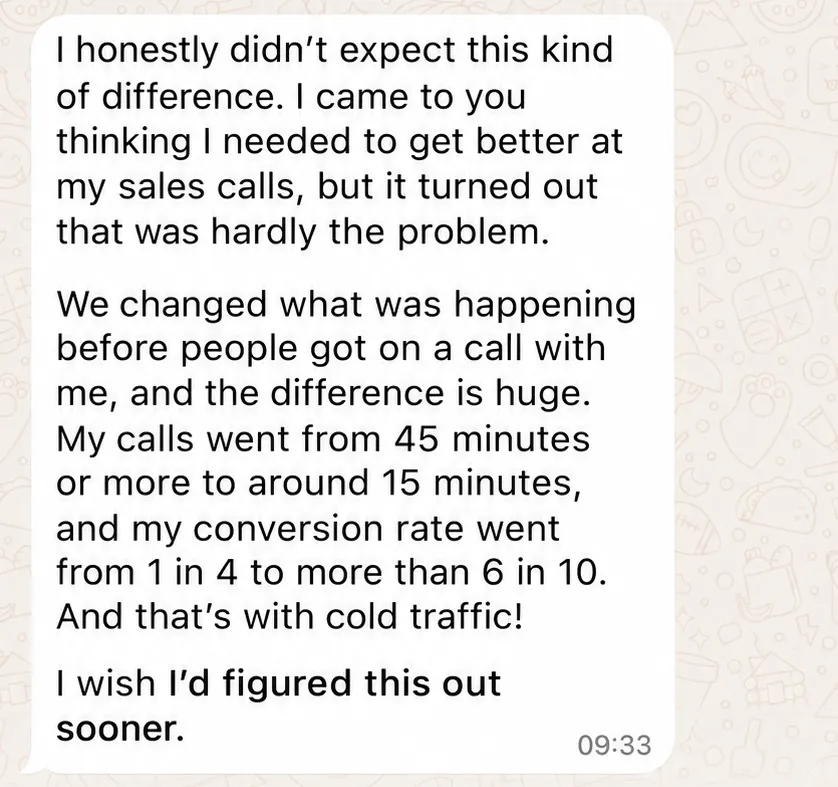
One of my clients put it like this:
“I don’t talk anyone round who is in doubt.”
Two of my clients, a few months after they stopped convincing
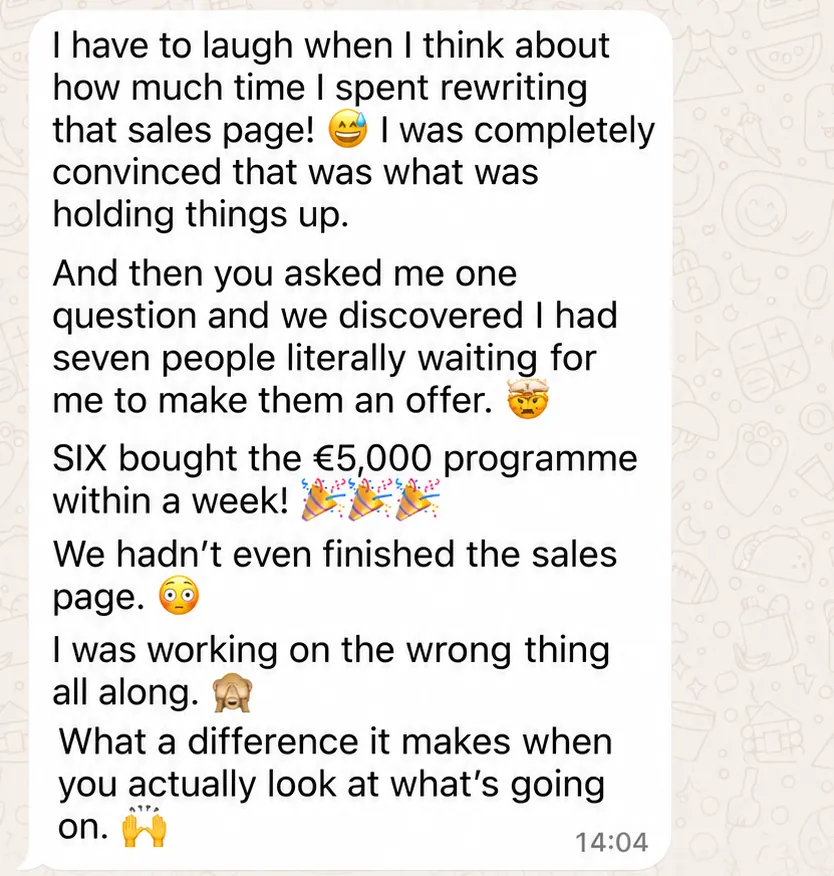
Want to hear how I went from twenty sales calls a month to none?
In 17 minutes you’ll hear what I changed so my clients decide before they ever talk to me, without more leads and without a new script. And where to look first in your own business.
In the audio:
- The three things I changed before the call, which took me from twenty calls a month to none
- How Nienke’s calls went from 45 minutes to 15, and why more than 6 in 10 of her cold leads now say yes
- Why more leads won’t make selling lighter, and what does
- How to tell whether your business only sells when you’re the one in the room
P.s. You’ll also get my emails, two or three a week. Each one takes something we were taught about selling and looks at it from the buyer’s side of the table. Read the ones you want and skip the rest. There’s nothing to buy if you don’t want to.
So who am I, then?
I’m Anneloes. I wrote a Dutch bestseller about why visibility is rarely the problem, and I live on Lanzarote with a calendar that is mostly empty, which is how I like it.
My phone is on silent. I don’t do sales calls, and I stopped chasing the algorithm. Most of my clients have already decided by the time we talk.
I help you build your own version of that, around how you like to sell.